“Break Free – When Relationships Become Toxic”
Art Exhibition by the Humboldt School for the International Day of Action Against Violence Against Women
Opening reception on November 27 at 4 p.m.
When is a relationship good for us? When does it allow us to grow and flourish—and when does it begin to restrict us, hold us back, or trap us? Students at the Humboldt School explore these questions in their art exhibition “Liberation – When Relationships Become Toxic.”
For the fourth time, the Humboldt School, under the direction of art teacher Thomas Böhm, is taking a stand against violence against women with its own exhibition. This year, the school is once again participating in a series of initiatives coordinated by the City of Bad Homburg through Ms. Hasibe Otter, Director of Equality, Diversity, and Inclusion.
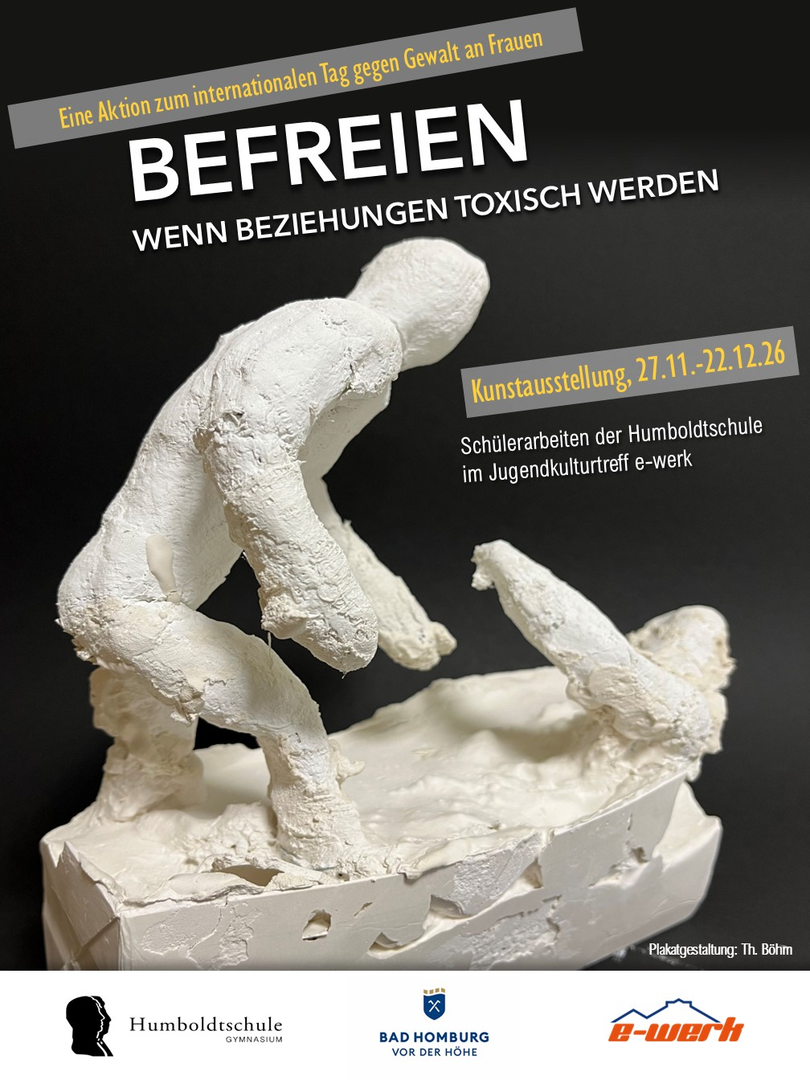
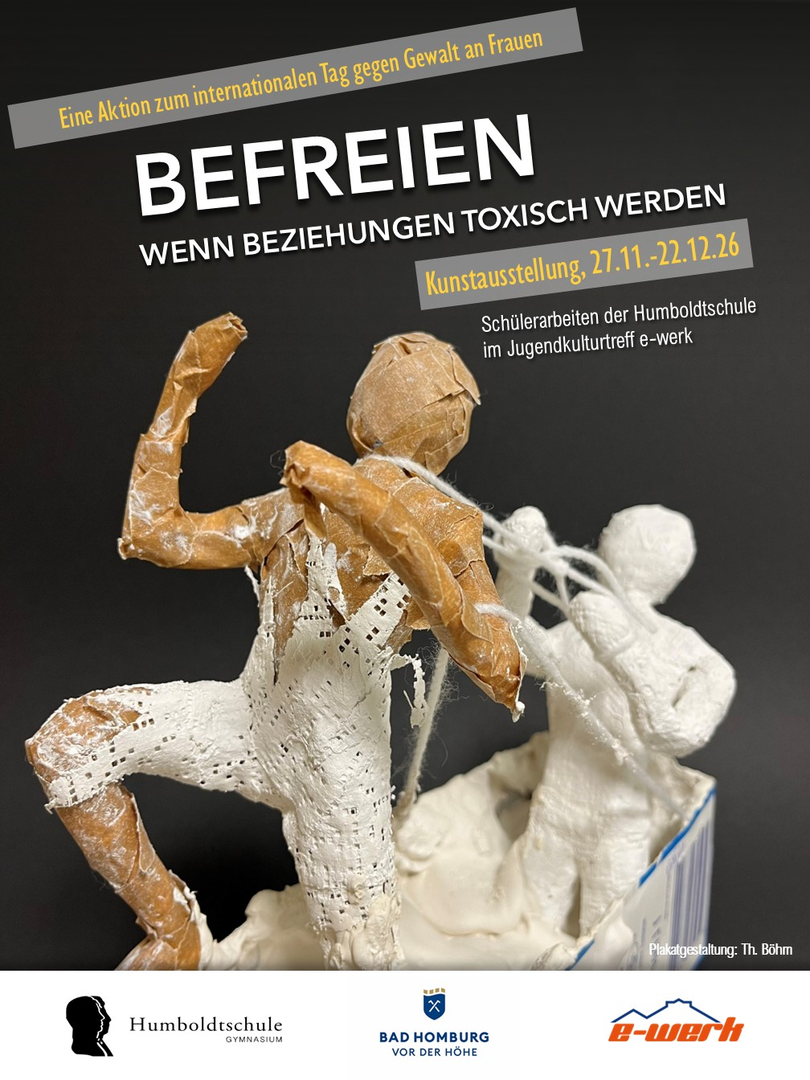
The art exhibition centers on approximately 20 small plaster sculptures created by students in a basic art course during the E-phase. The starting point for each piece was a block of plaster from which a figure symbolically attempts to break free. The resulting figures tell the stories of people who wish to break free from restrictive relationships and dependencies—sometimes held back by other figures, sometimes supported and encouraged by helping hands. Women, in particular, are sometimes trapped in relationships of dependency due to traditional power structures and gender roles, from which it is difficult for them to break free. The exhibition aims to raise awareness of this issue while also demonstrating that liberation is possible.
Photographic works from the advanced art class offer another perspective. In so-called “Multiplicity” photographs, students staged their mothers in various roles. The same person appears multiple times in each image: women navigating care work, careers, societal expectations, but also their own desires and longings. The images explore what it means to be a woman today.
The exhibition is organized by art teacher Thomas Böhm, who developed the project and stages it annually in public spaces. It is important to him to bring art to the public and to give his students the opportunity to participate in social discourses through art. The youth cultural center e-werk not only provides its space for this purpose but also supports the exhibition in terms of content and organization, represented by art educator Hayriye Gürler and director Dirk Piatkowski. “The e-werk is a great partner for us,” says Thomas Böhm. “This is where young people spend their free time, meet others, and strike up conversations through the exhibition. We’re very happy to be guests here. The issue of violence affects us all, but it can also be uncomfortable at times. Art can serve as an icebreaker to talk about feelings and personal experiences.”
The opening reception will feature speeches and live music.